
If your knees ache more on some mornings than others, or a stiff shoulder has just become something you work around rather than fix, you’ve probably already tried the usual suggestions — stretch more, rest more, maybe an occasional painkiller. Mud therapy tends to come up as an option somewhere in that search, usually described in fairly vague terms, somewhere between “ancient remedy” and “spa treatment.” So let’s actually get specific about what it is, what happens to the body during a session, and — importantly — what the research says rather than just what tradition claims.
What Is Mud Therapy?
Mud therapy, sometimes called peloid therapy in clinical literature, involves applying mineral-rich mud to the body, either directly to a specific joint or as a full-body pack, usually heated to a therapeutic temperature. It’s one of the older tools in naturopathy, often used alongside mineral water treatments in what’s broadly known as balneotherapy — the general practice of using natural mineral waters and muds for health purposes.
The mud itself isn’t just ordinary soil. Therapeutic mud, or “peloid,” is typically matured over a long period in mineral-rich water, sometimes for months, which changes its physical and chemical composition. This maturation process is thought to be part of what gives peloid its therapeutic properties beyond simple heat application — the mud absorbs and holds minerals from the water it develops in, and those minerals are part of what’s transferred to the skin during treatment.
A Practice With a Long, Global History
Mud and mineral treatments aren’t unique to any one tradition. Communities near the Dead Sea, hot springs across Europe, and various regions of India have independently used mineral-rich mud for joint and skin complaints for centuries, often built around naturally occurring hot springs or mineral deposits. What’s changed more recently isn’t the practice itself, but the fact that modern researchers have started actually measuring what happens in the body during treatment, rather than relying purely on generations of anecdotal use. That’s an important distinction, and it’s part of why mud therapy occupies a slightly different position than some other traditional treatments — there’s now real clinical data to look at, not just tradition.
What Actually Happens During Treatment
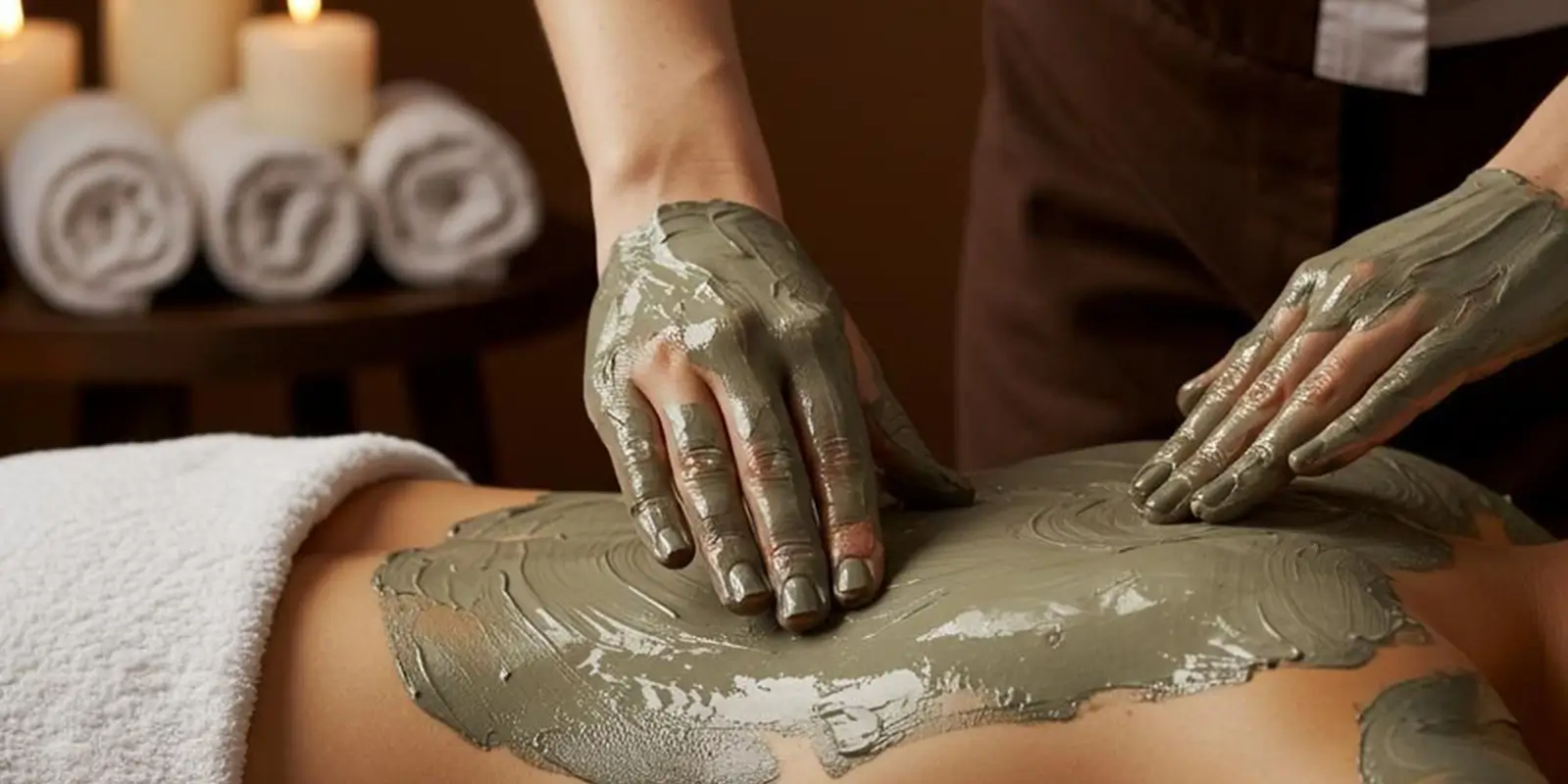
A mud pack is applied to the affected area — commonly the knees, lower back, or other joints dealing with stiffness — and left in place for a set period, often somewhere around fifteen to twenty-five minutes, before being rinsed off. The heat from the mud is the first thing you notice: it’s a deep, penetrating warmth rather than a surface-level one, closer to the feeling of a heating pad that holds its temperature far longer and more evenly. Most people find it genuinely relaxing rather than uncomfortable, and it’s common for muscles around the treated joint to visibly loosen by the end of the session.
Unlike a quick hot compress, the mud maintains its temperature gradually and evenly across the treated area for the full duration, which is part of why it’s used specifically for joints rather than as a general warming method. Once removed, the area is typically rinsed, and many people report the joint feeling noticeably looser and less stiff for hours afterward.
How This Differs From a Regular Hot Compress
It’s a fair question — if the main benefit were simply heat, would a hot water bottle or heating pad do the same job? The honest answer is: partly, but not entirely. Heat alone does relax muscles and can temporarily ease stiffness, which is why home heat application is a reasonable everyday tool. What mud adds on top of that is the mineral content absorbed into the skin during treatment, along with heat that’s held more consistently over a longer period than most home methods achieve. Some of the clinical research discussed below has specifically tried to isolate this difference by comparing mud-based treatments against standard heat or rehabilitation approaches, which is a useful way to understand where the genuine added value lies.
What the Research Actually Shows
This is where mud therapy is in a stronger position than some other traditional treatments — there’s a real, growing body of clinical research behind it, particularly for osteoarthritis, which is one of the most common causes of chronic joint pain.
A systematic review of studies on mud-bath and mud-pack therapy for osteoarthritis found consistent improvements in function, quality of life, and perceived pain among patients receiving the treatment. Multiple randomized controlled trials focused specifically on knee osteoarthritis have found that mud and mineral water therapy meaningfully reduced pain and improved physical function compared to control groups, with benefits that in some studies lasted for at least a month after treatment ended.
Researchers have also looked at why it works, not just whether it works. One recent study measured actual biological markers before and after a course of mud-bath therapy in elderly osteoarthritis patients and found reductions in inflammatory markers alongside improved neutrophil activity — a measure of immune cell function — together with better knee mobility and reduced pain. This suggests the effect isn’t purely psychological or just the relaxation of a warm treatment, but tied to a real, measurable change in the body’s inflammatory activity.
It’s worth being balanced here too: a systematic review comparing mud-pack therapy directly against standard rehabilitation approaches found the pain and tenderness improvements were statistically better with mud/mineral-based treatment, but not every measured outcome showed a significant difference between groups. Another comparative review of studies since 2000 found better long-term outcomes with mud and mineral water therapy compared to standard rehabilitation, though the researchers noted that study quality and design varied considerably across the field, which is a fairly normal limitation in this area of research. The honest summary is that mud therapy shows real, measurable benefit for joint pain and inflammation — particularly osteoarthritis — but researchers generally frame it as most effective as part of a broader treatment approach, not a stand-alone replacement for medical care.
Why This Matters for Naturopathy
This is genuinely one of the naturopathy therapies with the clearest research support for musculoskeletal complaints specifically, which is worth knowing if you’ve been skeptical about how much evidence exists behind traditional treatments. At Shankus, mud therapy is generally used for guests dealing with joint stiffness, mild-to-moderate osteoarthritis-related discomfort, or general musculoskeletal tension, often alongside other therapies rather than in isolation.
Hydrotherapy is a particularly common pairing, since both work on circulation and joint mobility from slightly different angles — hydrotherapy through contrast temperature changes, mud through sustained heat and mineral absorption. Herbal packs are sometimes layered in as well for guests dealing with more generalized muscular tension alongside joint-specific pain, since the two therapies address slightly different aspects of the same underlying stiffness.
If joint pain is a longer-standing concern rather than an occasional stiffness, it’s worth a proper conversation about what’s driving it before assuming any single therapy will resolve it — you can see the full range of naturopathy therapies we offer at Shankus.
[PRACTITIONER TO CONFIRM/EDIT: At Shankus, mud therapy sessions typically run for approximately X minutes, using mud sourced/prepared from X, and are generally recommended as part of a course of X sessions for joint-related concerns.]
Who Tends to Benefit Most
People dealing with chronic joint stiffness, mild-to-moderate osteoarthritis discomfort, or general musculoskeletal tension from age or repetitive strain tend to be the best fit for mud therapy. It’s also a reasonable option for people who find high-impact treatments uncomfortable, since it involves no manipulation of the joint itself — just sustained, even heat and mineral contact.
It tends to be less suited to acute injuries, active inflammatory flares, or conditions where heat is specifically contraindicated, which is why an initial assessment matters before starting rather than assuming it’s a universal fix for anything described as “joint pain.”
Who Should Be Cautious
Mud therapy involves real heat applied to the body, so it’s not appropriate for everyone. People with open wounds or skin infections near the treatment area, certain cardiovascular conditions, or acute inflammatory flares (as opposed to chronic stiffness) should check with both their doctor and a naturopathy practitioner before starting. Pregnant women should also seek guidance first, since heat-based therapies need extra care during pregnancy. As with any therapy discussed here, this is general information, not a substitute for an individual medical assessment.
Getting Started
If joint stiffness or aching has been quietly limiting what you can do day to day, mud therapy is genuinely one of the more evidence-supported places to start looking, especially when combined with a broader naturopathy assessment of what’s driving the discomfort in the first place. Curious if it’s right for your situation? Book a consultation at Shankus and our team can assess what’s actually appropriate for you.
Quick FAQs
Does mud therapy actually reduce inflammation, or is it just the heat? Research has measured real reductions in inflammatory markers following mud-bath treatment, suggesting the effect goes beyond simple warmth, though heat is certainly part of the mechanism.
Is mud therapy proven to help arthritis? Multiple randomized controlled trials and systematic reviews show meaningful improvements in pain and function for osteoarthritis patients, though researchers generally recommend it as part of a broader treatment plan rather than a stand-alone cure.
How is mud therapy different from just using a heating pad at home? Mud holds heat more evenly over a longer period and also delivers minerals absorbed into the skin during treatment — home heat application can ease stiffness temporarily, but doesn’t replicate the mineral component researchers have studied.
How many sessions does it usually take to notice a difference? This varies by individual and condition severity — a practitioner can give you a clearer sense after assessing your specific situation.
Can mud therapy be combined with other naturopathy treatments? Yes — it’s commonly paired with hydrotherapy or herbal pack treatments as part of a broader plan for joint and muscular concerns, rather than used as a single stand-alone therapy.
Is mud therapy safe for everyone? Not for everyone — people with skin infections, certain heart conditions, acute inflammatory flares, or who are pregnant should consult a doctor and practitioner before starting.
Sources: Systematic reviews and randomized controlled trials on mud-pack/mud-bath therapy for knee osteoarthritis (PMC/NIH; Karger Complementary Medicine Research); clinical research on peloid therapy’s effect on inflammatory markers and immune function (International Journal of Biometeorology); comparative reviews of balneotherapy and mineral water treatment for osteoarthritis (International Journal of Biometeorology).